Many of you have had life-changing life experiences where nothing is quite the same after you’ve had them. For some, these have been stressful experiences or even traumatic events that turned into a difficult situation and felt limiting, while for others they were uplifting, evoking personal growth and positive emotion. Some of you have had transformational moments that came from spiritual insight, cognitive behavioral therapy, or mindfulness techniques that encouraged a more positive perspective. But no matter the source of the change, how we perceive and respond to these challenging situations in our everyday life determines their ultimate impact.
I have seen clients turn the most negative experience or negative thought patterns into remarkable advantages. And others who have been given the most incredible opportunities yet pushed them away because their negative self-talk and negative point of view made the opportunity confusing, scary, or troublesome.
For example, I worked with a client I’ll call “Joe,” whose parents were both deaf/mute. Growing up, being able to sign and having parents that were “different,” he developed a lot of resentment. Ashamed and embarrassed to bring his friends home, he was certain his association with this marginalized sector of society made him different, and he didn’t like it. He came to me, decades later, concerned that his public speaking career had stalled. He was a well-thought-of speaker. But he hadn’t gone really big.
In a session he finally realized what his block was: he still felt inferior at some level and not worthy of success. And that block, in turn, was related to his parents and his judgement. His breakthrough moment came when he realized: What is given to you in your life is given to you so that you can breathe life into it. In other words, what seems to be a burden usually contains your life purpose, a silver lining that, when seen in a positive light, can completely transform your emotional well-being.
Suddenly, he realized his parents’ challenges had set him up to win in a very unique way. The perceived burden he’d grown up with was actually a gift and an opportunity. At that point he shifted the tone and topic of his inspirational speeches to include the negative emotions and feelings of inferiority he once carried, and how important it is to adopt a new perspective and break free from negative thinking. He spoke about different ways to approach life’s difficult times and how cognitive reframing techniques can help us see a negative situation in a more positive outlook. Very quickly his career skyrocketed, and soon he found himself invited to speak at a million-dollar round table. He invited his family members to be there and introduced his parents to the audience at the opening of his speech. Using sign language, he told them, “Because of you, me. Thank you.”
There wasn’t a dry eye in the room. He had pivoted from shame, blame, and lower emotions to understanding that he had everything he needed to succeed. He explained the helpful way the mind can be trained through cognitive restructuring to replace unhelpful thoughts with positive perspectives, and how this shift improves mental well-being and even physical health. He emphasized that what once seemed like bad things could be reframed into opportunities for better outcomes.
Contrast this scenario with the experience I’ve had with so many clients who, faced with an incredible opportunity—a new career, an investment opportunity, a job offer—shot these opportunities down, leaning on common cognitive distortions like “If it sounds too good to be true, it is too good to be true.” Or “Better to stick with what you know than to stick your head where it doesn’t belong.”
Really?
The Opposite of Stuck
Once we create the habit of searching for and finding what is good and useful in every situation—no matter how seemingly awful—we cannot ever be stuck. We are growing. Once we are growing, that ignites neural changes and supports positive thinking that release healthy hormones in the body, building resilience—the ‘don’t quit’ factor that helps us navigate specific situations with strength.
Our brains become habituated to generating positive thoughts. We experience higher, constructive feelings that inspire useful actions and create positive outcomes. We finally get to see for ourselves why and how positive people seem to have better lives. It didn’t just happen. They taught themselves the art of the reframe.
Reframing Family
One area of reframe that can produce profoundly positive results is our relationships with our parents. Like Joe in the above story, many people have chips on their shoulders or heavy baggage around parental relationships. I often hear, “Because of my mother/father I cannot _____.” Or “It’s my parent’s fault that I’m ____.” Or “My mother/father is a narcissist and there’s no place for me to shine.” Or “My mother/father disapproved of my choices therefore I could never fulfill my potential.”
My question for anyone stuck in this rut is: “How long are you going to keep blaming your parents for decisions you’ve made about the relationship, and how much longer will you refuse to grow up?” That might sound harsh, but it’s the truth. How you respond to what happened to you as a child is up to you. You can either choose to stay crippled by events and circumstances or use the situation to grow mightily. Pick one.
Just be aware that whatever path you take, you are the one who is choosing it.
Art of the Reframe
If you take reframing whatever happened to you in the past seriously, you will see measurable results within months. Depending on the chosen reframe and your commitment to it, you’ll see changes in your life and the way you feel pretty quickly,
Your reframe:
- Write down an area you are not doing well in your life—money, relationships, health, etc.
- Write down your thoughts, feelings, and actions are around issue. (I’m not going to make it. I’m devastated. I’m blocked. I’m panicking. I cannot move. Etcetera.)
- When did that pattern start for you? What was happening in your life at that time? (If this is happening for you right now, you are in luck. If you reframe that right now you will not have to suffer the consequences of your negativity in the future!)
- What have you made this mean about you/others?
- Read and contemplate the insight “Joe” had because it’s pertinent for EVERYBODY. What has been given to you was given so that you can breathe life into it. In other words, your reframe is about purpose. Your purpose in life, or at least part of it, is staring you in the face, asking you to frame it well.
Let me give you an example: Let’s say you come to me as a client who is experiencing extreme depression. You tell me all the men or women in your family are depressed, and thus it seems obvious that your fate is sealed.
No, it isn’t.
- Ask yourself with an open heart, “What can I learn here? How can I grow this into something that becomes valuable in my life?”
- Now take a deep breath and look at all those who came before you stuck in this pattern and say to yourself: “Like them, I may not know what to do right now, but I can figure it out. I got this.” And exhale.
- If you do this intentionally, feeling it in your head, heart, and gut, you will feel a movement. It may be very subtle, but it is there. Perhaps you shift from being depressed and stuck to being depressed but willing to look at new possibilities. Well done! This is movement in the right direction!
- Now, write down one new thing that will add value and growth to who you are in this situation.
This new thing doesn’t have to be Earth shattering. Maybe when people greet you saying “Good day!” you make the decision that you will never again respond with “What’s so good about it?” Instead of responding that way to people maybe you choose to smile instead and just nod. And use the moment for some reflection about what is good about the day. It’s sunny. It’s not too hot. You found a parking spot. Your favorite barista is making coffee at the local coffee shop. You get my point.
Can you see how this kind of reframe—this kind of choice for “one new thing” can also end up being your purpose? That maybe part of your purpose is breaking the family pattern of depression in your system?
One of my clients moved from being a pessimist to being known as Sally Sunshine. Seriously. She went from seeing herself as negative and broken to being the one that others sought out for comfort and upliftment. Her next step will be to finally say “Yes” to her purpose, part of which is obviously to be a light in the world to those around her.
This may sound simple and too easy to make a difference, but this is how neuroscience works. You are the one in charge. You are the one who chooses. And you either wither or grow from that choice. You are the one rewiring your brain and writing the script for your life. And there are no limits to how far you can grow when you do.
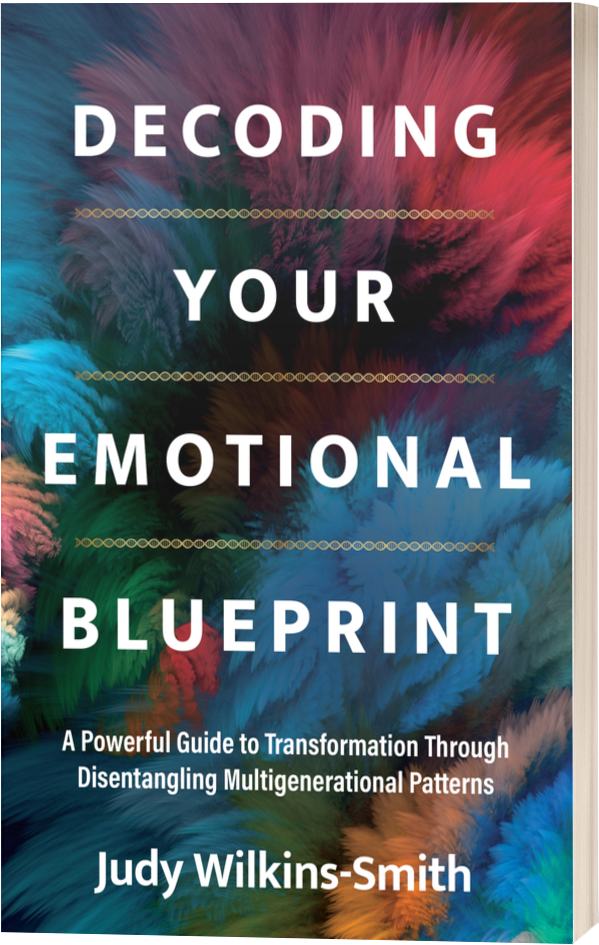
Access your free chapter of Decoding Your Emotional Blueprint
Uncover the secrets of your Emotional DNA and start transforming your life today. Get the first chapter of Decoding Your Emotional Blueprint by Judy Wilkins-Smith for FREE and take the first step toward remarkable change!