During live events I consistently notice how people are stuck in the past and attached to their stories. They can see the story. They can see the next logical step to take to go beyond the story, and then hesitation creeps in. Many stop right there. Others come at the exact same issue, just from a different angle. It’s almost hypnotic, as though the story had placed a spell on them and they cannot put it down. And the question is “Why?”
All too frequently I find the participants who are stuck in the past, reliving past experiences and the stories of their ancestors, are not fully in the present moment. As well, they can’t seem to see a different story with a different future. If I ask them what happened to their ancestors or what the traumatic event was for them, they can dive headlong into that, excitedly providing endless details including thoughts, feelings, and actions.
But when I ask them what their desire is, they look at me blankly, disconnected from their present life, unsure how to create new possibilities or move towards a better future.
Heavy Furniture
If you look at ethnic demographics with particularly dramatic and heavy events in their history, such as the Holocaust, slavery, diasporas, ethnic cleansing, pogroms, etc., these are the kind of emotionally fraught events that produce stories that descendants struggle the most to break free from.
Often a family member wants to right the wrongs, take up the fight, or grieve the losses indefinitely. Quite often descendants are so wrapped up in their history they are unable to find their own future or even engage in their daily life meaningfully.
This tendency is compounded when people feel they must carry the emotional load of others. What started as grief can become a heavy burden. They become paralysed, unable to take even a small step forward, fixated on old memories, past injustices, or the idea that reliving pain is the only way to stay loyal to where they came from.
They struggle to see that the outside world offers new choices, new opportunities, and even new experiences. If only they allow themselves to consider different directions.
So strong is the systemic trance that they would rather die fighting, repeating, or grieving than finding a new way to explore what’s possible. Over time, this meta pattern then creates generations of resentful, angry descendants demanding their rights as though they could restore them to those who came before them. Often this pattern is sparked by traumatic experiences, and sustained by negative emotions and unresolved issues from past relationships or past mistakes, creating wounds that were never healed or fully processed.
This hypnotic fascination with their ancestors’ story is called being in a systemic trance. They have been captured by the familiar. Add loyalty to the story and the people involved and the whole thing becomes quite seductive. It takes careful attention to the telling to see exactly where the participant is entangled. It takes equal attention to the words they use to describe everything, the systemic language being spoken, and their reaction to feedback to understand what belongs to the client and what belongs to someone from another generation.
Frequently clients become agitated when invited to set the limiting pattern down. It requires a movement and language that gives the pattern its place so that the client can set it down with gratitude or understanding and step away from its limitations, pivoting to the resulting positive change. Additionally, it requires a genuine desire to move, an essential step in their personal development and healing.
They are often clinging to negative thoughts, replaying past trauma in loops, stuck in old habits and behaviors that served them once but no longer align with their current reality. Many fear that embracing positive thinking, new tools or even surrounding themselves with supportive people means abandoning their roots.
But what if it simply means honouring those who came before while consciously choosing your own path?
So, how attached are you to your own limiting story?
Story Exercise
-
Write down a pattern or an issue that is a problem for you.
-
Now write down all the reasons why it is a problem.
-
Next, write down all the reasons why you cannot move past it. (Aka all of your wonderful excuses for staying stuck, no matter how reasonable they may seem.)
-
Look to see if anyone in your family or community has a similar pattern.
-
Now look to see why your heart believes this is a pattern you must follow.
-
Notice to whom you are being loyal by following this pattern. In other words:
- “I have to because …”
- “I can’t change this because …”
- “I have no other choice but to …”
- “It’s too much work …”
- “My mother, father, brother, sister (etc.) struggled thus so must I.”
- “How dare I advance when others do not?”
- “That’s just the way it is.”
- “My mother, father, grandfather, grandmother (etc.) got stuck here, and so I cannot move forward.”
- Sad
- Mad
- Hopeless
- Frustrated
- Resigned
- Other
Do you recognise emotional responses tied to past events, previous relationships, or bad experiences that never got resolved? Are you stuck in the rearview mirror, unable to access the richness of your current life?
Ask yourself on a scale of one to ten how much you want to change this. And do you want to change this for you? Or to please someone else? Now, having looked at all of the answers above, ask yourself: “On a scale of one to ten, how attached am I to my story and why?”
What might happen if you set it down? Who might you upset or let down? What might change in your life? What would you have to do differently? What would it cost you? What would be the benefit? Would you have to let go of the past? Would you have to let go of your victim-self? Who might you be if you did that?
What if that act of courage became the first step toward your healing, your clarity, your sense of purpose? What if it created new memories, better habits, and introduced you to social groups and new hobbies that reflect who you are becoming, not who you were?
The Joy of Change
We are only as small or limited as we choose to be. Being attached to your story requires a lot of hard work and reinforcement. The question is: Is this where you want to focus your attention and life energy? Or is there something else that would bring you more satisfaction and excitement?
As I work with clients and they have breakthroughs, they’re often surprised by the joy and enhanced quality of life they experience once they let go of an old story and start creating the life they would truly like to live. Asking yourself every day, “What more is possible?” or “What do I really want?” produces surprising results.
Acting from these kinds of questions, you start creating from your creative part of the brain, and this changes your Emotional DNA and the stories attached to it.
This isn’t about denying the good moments or the valuable lessons of the past. It’s about refusing to let negative experiences or circumstantial triggers define you. At the end of the day, the only thing keeping most people stuck is the belief that they can’t create something new. That the way things were is the way they must stay.
If it seems like your story cannot or will not shift, the question to ask is: “Who am I not seeing? Who (what family member) needs to be acknowledged and given their place so I can pivot out of their old story and into a new story of my own making?”
Change comes when you can accept that what happened happened. You can then choose to do life differently with joy and aspiration. In this way you change the old story and imbue the new story with hope, appetite, and a determination to give the next chapter of the family tree a very different flavor. Such change agents understand that while complex trauma and emotional pain may leave marks, they don’t need to dictate the outcome.
When you choose to live a rich, full, and happy life, not only do you break free of the limiting aspects of your family stories, you create a new place from which to grow, aligned with your personal growth journey. You find practical strategies for navigating social situations, you explore different ways of thinking, and you surround yourself with people who want to see you thrive.
And that is the beginning of a new world. If you want to make a difference, this is how it starts.
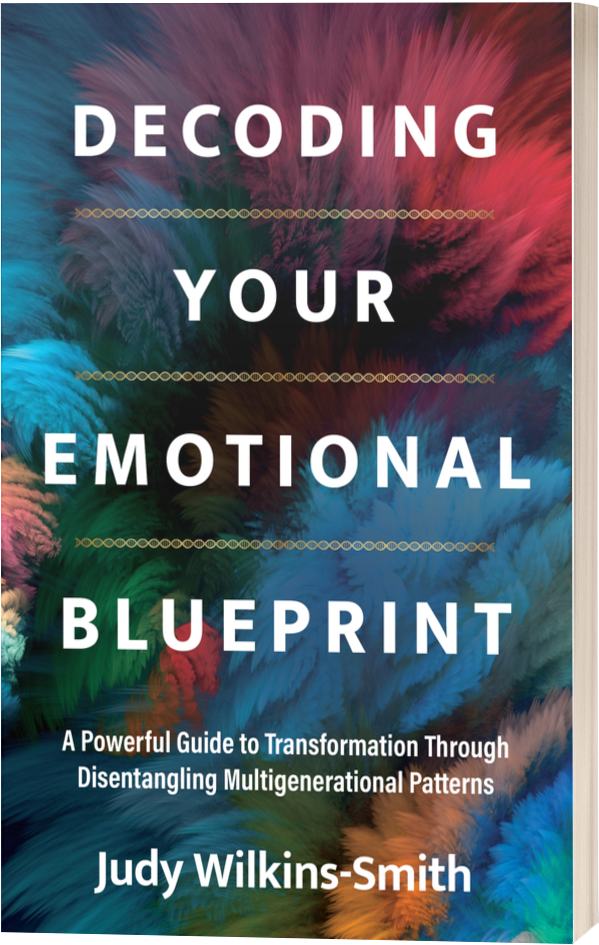
Access your free chapter of Decoding Your Emotional Blueprint
Uncover the secrets of your Emotional DNA and start transforming your life today. Get the first chapter of Decoding Your Emotional Blueprint by Judy Wilkins-Smith for FREE and take the first step toward remarkable change!