Why am I stuck in the past?” It’s a question so many of us ask, yet the answer rarely comes from simply thinking about it. If you’ve been having a hard time letting go or find yourself reliving past events and past experiences that keep triggering the same emotional pain, you’re not alone. The first step toward healing is often simply seeing the pattern clearly.
It’s one thing to intellectually grasp an idea or an issue. It’s totally another thing to see it and walk through it in three dimensions! There is so much more information available to us working in 3-D. Relationship dynamics, belonging dynamics, and whether a situation is displaying proper order are just some of the insights easily garnered through the use of a constellation. The more senses we engage, the deeper and more profound the insights, shifts, and decisions we can make.
People who learn to work in 3-D find themselves more easily able to navigate complex problems and are much less likely to stay stuck. Frequently, during a systemic constellation work event, we use live representatives to literally “stand in” for each person and part of an issue a client presents. This allows us to very quickly see the issue being tackled as well as the connections and disconnections between all the people involved.
Many people spend much time in therapy, exploring methods from talk therapy to eye movement desensitization, yet still feel trapped by old memories and negative emotions that surface in their daily routines.
However, unless you’re in a workshop, you don’t always have groups of willing people available to stand in whenever you want to explore a family, work, or social issue. Sometimes we’re on our own. Sometimes we want privacy and time to explore a pressing issue on a smaller scale. Perhaps a traumatic event or a series of traumatic experiences has shaped your emotional state for a long time – maybe your entire life.
No, you don’t always need human representatives for a constellation. You can always use pieces of paper with names of people and problems written on them, and arrange the papers on the floor in what feels like a representative pattern. Then you walk through and explore that pattern to see what information/insights come up.
But there is another easy way to dimensionalize a personal issue. Chessboards and pieces make the perfect do-it-yourself constellations toolkit. Even each row of squares can be used to quite accurately represent an entire family generation.
The funny thing is, one of the most powerful tools for personal growth and understanding your current life might already be sitting in your closet.
You can assign the king, queen, knights, bishops and pawns to represent father, mother, siblings, grandparents, other relatives, people of influence, neighbors, your dog, you name it. Literally, you name it.
These pieces can represent family members across generations carrying past hurts and patterns that have quietly shaped who you are today.
As you set out the pieces on the board, note the direction each representative is facing by either marking the pieces with an arrow using a dry-erase marker or by using small stickers to denote the “face” of each piece. This is a quick and easy way to explore an issue or illuminate a pattern that lives in the family or in a business situation.
Not only do you get a better dynamic sense of the issue, you also get a quick yet graphic picture of the origin of the issue, as well as the people it’s impacting right now.
How to Create a Constellation
I started using this as a logical and neutral way to explain what I was seeing while working with my clients so that they could see it too. It worked so well that I now suggest this approach to anyone wanting to explore family issues, social issues, business issues etc. in small groups or on their own.
Chess is, after all, a game of patterns and movements with logical pathways and consequences. It shows us quite quickly how patterns can be passed from one generation to the next (or one line of authority to the next in a business) as well as the pattern’s origins and the impacts it creates.
What begins as bad things happening to one generation can quietly become the only thing a future generation knows, until someone chooses new ways of moving forward.
Here is a quick step-by-step example of how to use a chessboard to effectively create a constellation:
1. Identify a place where you have been stuck/mad/sad for as long as you can remember.
2. Take one of the chess pieces to represent the issue and set it to one side.
3. Use the king and the queen to represent your father’s side of the family and your mother’s side of the family.
4. Place them next to each other facing forward, each on their own square.
5. Now take the chess piece that represents the issue and place it in relationship to the pieces that represent your father and mother.
6. Notice where you placed the chess piece issue. Is it closer to your father or closer to your mother? Think about it. Does either parent have a similar issue to the one you are experiencing?
7. Identify the family line to which the issue may belong.
8. Whichever line it is, set up chess pieces one behind the other – each on their own square, representing grandparents, great-grand parents, etc.
9. Take the chess piece that represents the issue and move it back one generation at a time until you sense the generation to whom the issue belongs.
10. Then, move it one generation behind that and see how that feels. If it feels easier, then this is the generation in which love, and life flowed easily. If it does not feel easier, keep moving it backwards. The issue may be further back than you thought.
11. Once you’ve identified the generation to whom the issue belongs, choose a chess piece to represent yourself.
12. Place the piece that represents you in front of the family line, facing the previous generations and the issue.
13. Place your finger on top of that chess piece and tell the chess pieces for the issue and the family member where it all began: “This doesn’t belong to me. It belongs to you. So many generations have carried this and now it is time for me to do it differently. I will leave this issue with you.”
14. Then, speak to the family member one generation behind the issue, telling them “Love and life flowed through you and then the flow stopped. I am the one to restore that flow.”
15. Always remember that what is now a problematic issue was once a solution to a pressing situation that is no longer suitable. Thank the issue for all that it brought and let it know you will use it as a source of wisdom.
16. Notice how quick and easy this exercise was! It can be profound if you stay present and allow yourself to engage with your family system and the knowing field—the energetic and systemic field that holds all the memories, emotions, and hidden dynamics of a family system (or any system) that is always present, transcending time and space.
A chessboard is such an easy and noninvasive way to begin a systemic conversation, even if that conversation is only with yourself at first. It effectively introduces you to the concept of systemic work and generational issues that also, by the way, show up in boardrooms and corporate settings.
Try this for yourself and let us know how it works for you!
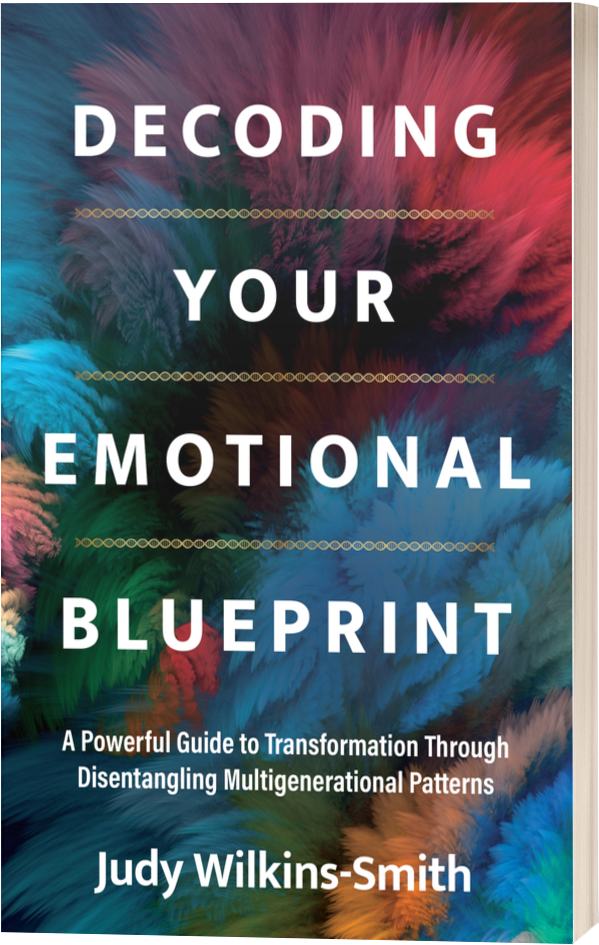
Access your free chapter of Decoding Your Emotional Blueprint
Uncover the secrets of your Emotional DNA and start transforming your life today. Get the first chapter of Decoding Your Emotional Blueprint by Judy Wilkins-Smith for FREE and take the first step toward remarkable change!